Vincenzo Florio
The Florios of SicilyVincenzo Florio’s life is shaped by a precarious beginning, an uncle’s inheritance, and an ambition to make the Florio name impossible to dismiss. He grows from a child whose safety depends on others into a businessman who thinks in terms of fleets, factories, markets, and succession. Yet his ascent does not resolve the tensions at the heart of his story: the family enterprise demands loyalty and “good blood,” while the women and children in his household bear the consequences of his choices; his vision for Sicily’s future, meanwhile, repeatedly collides with political realities beyond his control.
Identity and Early Dependence
Vincenzo enters the story as an infant in danger during an earthquake. His mother, Giuseppina, wakes to the tremors and tries to reach the cradle suspended from the ceiling beams, but the wicker basket swings violently. The scene establishes his earliest condition through others’ fear and care: before he can act for himself, his survival depends on a household trying to protect him from forces it cannot master.
He grows up fatherless, in the care of his uncle Ignazio and his mother. Years later, the contrast between childhood dependence and adult authority remains visible in his attachment to Ignazio. In one childhood scene, Vincenzo clings to his uncle’s neck and points toward a ship while Ignazio covers him with his cloak against the tramontana wind. The moment places the sea and shipping within his early world, but it also shows the closeness of the relationship that will guide his upbringing and shape his inheritance.
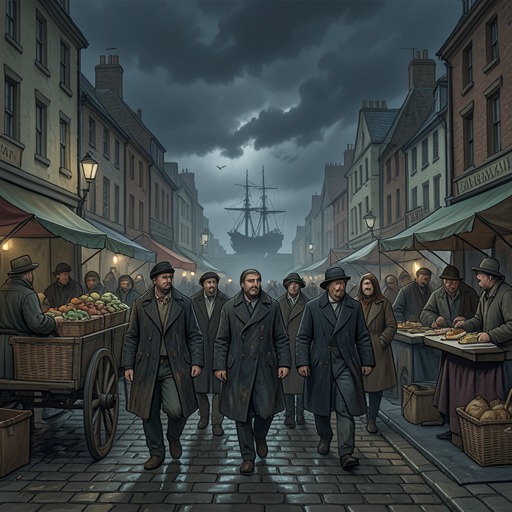
The family’s economic world is already connected to long-distance trade. A cinnamon stick or gingerroot passes through many hands, travels by mule or camel in caravans, crosses the ocean, and arrives at European ports before reaching a counter. By the beginning of the nineteenth century, British and French merchants dominate the spice trade that had once enriched Venice, bringing medicinal herbs and other colonial goods, including sugar, tea, coffee, and chocolate. The Florios enter a commerce whose routes and suppliers extend far beyond Palermo, and Vincenzo’s later expansion grows from this trading environment.
Apprenticeship and Inheritance
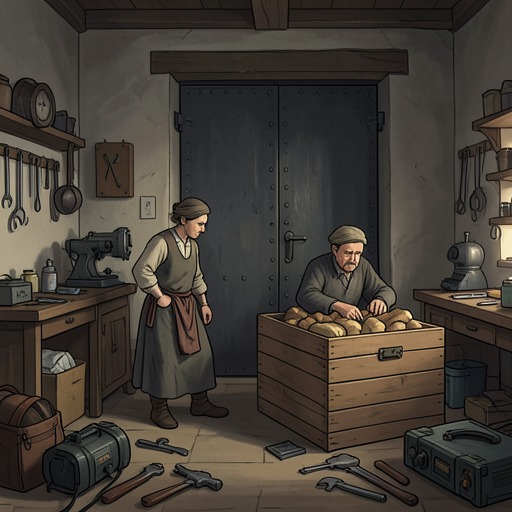
The family firm advances by managing not only what it buys but where and when its goods are taxed. The Florios rent a warehouse within the Palazzo Steri property, behind the customs offices. Its guarded rooms hold spices in transit or awaiting sale; import duties are paid only when goods actually enter Palermo. The stock includes Indian spices obtained through British suppliers, goods from French colonies sold in Livorno and across the Tyrrhenian Sea, and other high-quality products from around the Mediterranean. The Florios are not yet as wealthy as the Canzoneris, but their position has improved markedly.
Vincenzo’s apprenticeship is practical and numerical. As a teenager, he reads earlier account books with Ignazio, comparing quantities of goods against income and expenditure. Bark is their most important resource, though the business extends beyond it. This attention to records gives him a working knowledge of the enterprise as a system of purchases, products, and returns, not merely as an inherited name.
His adolescence also tests the uncle who has raised him. Ignazio sees in him a restlessness and rebelliousness that he has not known how to handle; Vincenzo’s self-confidence can run ahead of his experience. At fifteen, he asks to take a walk because his head feels foggy, while Ignazio is already exhausted from carrying the business and family responsibilities. Ignazio later recognizes that the troubling side he had sensed in his nephew has surfaced and cannot simply be pushed back. Vincenzo’s force of will will serve his ambitions, but it will also make him difficult to restrain.
Ignazio’s death leaves Vincenzo to confront a form of solitude he has never known. He asks what he will do without his uncle, and the loss is bound up with the transfer of responsibility: he must continue not only a business but a life’s work. When he opens the store in Ignazio’s accustomed manner, workers arrive and Ignazio Messina brings news from La Cala. The continuity of the daily routine marks the change in who must now sustain it. Vincenzo’s inheritance is both material and practical, and the young successor must make the business his own without severing it from the man who built it.
Building the Enterprise
As head of the firm, Vincenzo treats growth as an active obligation. He argues for a business arrangement in which a partner’s money is genuinely at stake: one third for the partner and two thirds for Casa Florio, continuing the investment already made in the land. His proposal joins personal participation to the company’s capital, showing how he tries to recruit partners without surrendering the enterprise’s central claim on the venture.
His ambitions extend beyond the family’s established lines. He points to large-scale trade in tuna preserved in oil, a product the firm has canned and sold for years as demand grows. He also cites his purchase of the Oretea foundry from the Sgroi brothers. Others have dismissed the idea of establishing a workshop in Palermo, arguing that only small shops can survive there; Vincenzo counters that the island will remain behind if no one thinks on a larger scale. He invokes the proverb about the mouse eventually boring through a nut, making patience and persistence part of his case for innovation.
The ambition is not abstract. At a meal, Vincenzo brings out bottles of Marsala from his cellars, some still carrying a fine layer of dust. He presents the wine as a special reserve kept for an occasion such as this, and the guests sample it in small, tulip-shaped glasses. The scene makes a commercial achievement tangible: a product of his own cellars appears at the table as proof of what the enterprise can produce, preserve, and share.
Vincenzo also imagines the business as an inheritance that must outlast its founders. What he and Ignazio have built, he insists, cannot be left to wind and rain; it is an heirloom to be safeguarded and passed on, and that future requires “good blood.” The language reveals the double meaning of succession in his thinking. The firm is a commercial creation, but he also treats its continuity as a matter of lineage, binding family identity to business survival.
Family, Authority, and Consequence
Vincenzo’s authority within the family is inseparable from a social order in which women have little power over marriage. Giuseppina recalls that she was fourteen when her father married her off, and asks whether she could have rebelled when Vincenzo brought her away. Mattia likewise tells her that wives are treated as their husbands’ property and have no power. These statements establish the constraints within which the women around Vincenzo make choices, and they give his later household arrangements a wider context than personal preference alone.
When Giulia tells Vincenzo she is expecting his child, the disclosure changes the stakes of their relationship. In a later discussion with her parents, Vincenzo says plainly that he will not marry her because he has other plans on that front. He says he will take responsibility and wants to keep her under his protection, but insists that she not be turned out of the house. His offer provides a form of material security while leaving the central imbalance intact: he sets the terms, and Giulia’s position depends on his decision.
Years later, Giulia names the cost of that arrangement. She recalls living with their children for years without rights, afraid that Vincenzo might cast her out in order to marry a noblewoman chosen by his mother. She refuses to let Angela and Giuseppina face the same humiliation or marry men who despise them merely to protect Vincenzo’s interests and those of Casa Florio. Her challenge turns the family’s strategy of preserving status back on itself: a concern for the Florio name cannot justify passing its injuries to the next generation.
Vincenzo’s own vision for his son exposes another side of his social ambition. He tells Ignazio that riding, dancing, travel, and seeing the world should prepare him to move beyond Sicily and enter aristocratic society. The Florios, he says, can buy what established families own, and his son has resources that Vincenzo himself did not possess when he began with what his uncle left him. He wants Palermo and its residents to recognize that the Florios are inferior to no one. The speech makes wealth both the result of Vincenzo’s work and an instrument for overcoming the class exclusion he has experienced.
Political Action and Late-Life Memory
Vincenzo’s business and political lives meet during the revolutionary crisis. He tells his family that he has bought a large consignment of rifles from England on behalf of the revolutionary committee, an act he fears he may regret. The Kingdom of Sicily has been proclaimed, but no candidate will accept its crown: neither the son of Carlo Alberto, the Duke of Genoa, nor another prospective ruler. Vincenzo explains that British opposition to Sicily’s separation from the Bourbons has narrowed the revolutionaries’ options. He also recalls the parliamentary elections of the previous March, which selected four noblemen and wealthy men in an effort to revive the 1812 constitution, but left the new political order without a king as a point of reference.
His account places his purchase within a broader pattern of pressure on the family’s assets. Their ships have been requisitioned, and they have effectively been forced to provide a loan as well. Vincenzo’s decision to supply rifles is therefore neither detached speculation nor a simple declaration of political faith: it comes amid demands on the firm’s shipping and money, and at a moment when the revolutionary government lacks a settled constitutional and royal framework. The episode shows him accepting risk in a political struggle whose outcome remains uncertain.
In later years, Vincenzo continues to act through financial and institutional channels. He tells an interlocutor that the information he is providing demonstrates his full knowledge of the Royal Bank and that offering it exposes him to considerable risk. He taps the briefcase on his lap, the same one he had taken to the Royal Bank days earlier. The gesture connects his authority to information and access as well as to visible commercial assets: the firm’s power rests on what he can know and put forward, not only on what it owns.
The final glimpses of Vincenzo complicate the image of the forceful patriarch and businessman. In old age, he asks to speak to his mother, and after his stroke he is not unconscious: he remembers. The distinction matters because it leaves him inwardly present even as illness has changed his condition. His life has been organized around action—opening the store, making investments, bargaining over shares, and pressing his ambitions—but its closing note is memory, the consciousness that remains when action can no longer define him.
Narrative Significance
Vincenzo’s career binds the rise of a commercial family to the larger transformations of Sicily. Spice imports, bark, tuna, wine, and industrial investment carry the plot from the warehouse and account book to new ventures and political risk. The goods are not decorative markers of wealth: each points to routes, labor, suppliers, capital, and changing markets, while Vincenzo’s appetite for expansion reflects a determination to make Palermo more than a small-shop economy.
That outward movement is matched by a persistent inward contradiction. Vincenzo wants the Florios to be accepted by aristocratic society and to preserve the family enterprise for the next generation, yet his understanding of inheritance can turn family members into instruments of that project. Giulia’s confrontation forces him to hear the human cost of a system he helped sustain. The business may be an heirloom, but the story asks who pays for its transmission—and whether the children who inherit its wealth can also inherit a different measure of freedom.